Online Ruler (Actual Size)
An on-screen ruler that starts with an estimate. Save a mapping with a compliant bank card or screen size, verify it, then measure in centimeters, millimeters or inches.
Display settings
Calibration details
Resulting density: 96.0 PPI · Not calibrated · estimate only
Verify against a physical reference. Different displays can report identical parameters; display changes cannot always be detected.
Press and drag across the ruler to measure a distance in cm and inches.
Keyboard: focus the ruler and press Enter to start at zero, then Tab to − or + to adjust.
How to calibrate this ruler
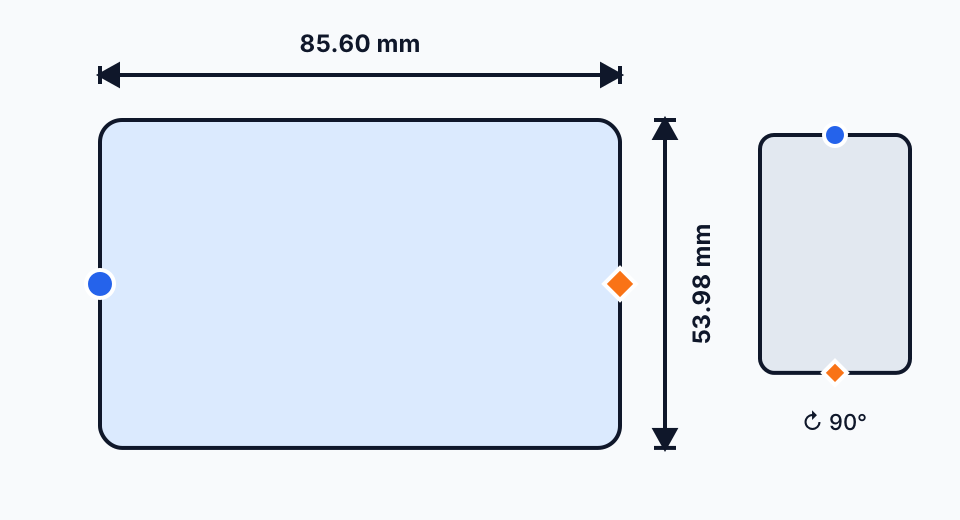
Method 1 — Bank card (recommended)
Use only a bank card known to follow ISO/IEC 7810 ID-1 (85.60 × 53.98 mm). Choose its placement and long or short reference edge, align the fixed circle, then move the diamond with the slider or ± buttons in 0.5 CSS px steps. Save and verify the result on the ruler.
Method 2 — Screen diagonal
Browsers cannot detect a display's physical size, so an automatic value is only an estimate. Look up your device's visible-panel diagonal in inches (in its specs or manual), enter it in the calibration dialog, then verify the calculated pixel density with a physical reference.
How actual size works
- The browser reports your screen resolution and pixel ratio, but not its physical dimensions.
- Calibration saves the CSS pixels per inch measured from your chosen reference; the saved state is not itself proof of physical accuracy.
- Ticks use that mapping (1 inch = saved CSS PPI; 1 mm = PPI ÷ 25.4). They are intended to match physical distance at the current display and zoom, so check them with an independent reference.
Before you measure
- Keep browser zoom at 100% (press Ctrl/Cmd + 0) — zooming rescales pixels and breaks the size mapping; the ruler warns you when it detects this.
- JavaScript must stay enabled; all calculations run locally in your browser and nothing is sent to a server.
- Hold the object flat against the screen, aligned with the 0 mark of the top, left, or right ruler.
When to use an on-screen ruler — and when not to
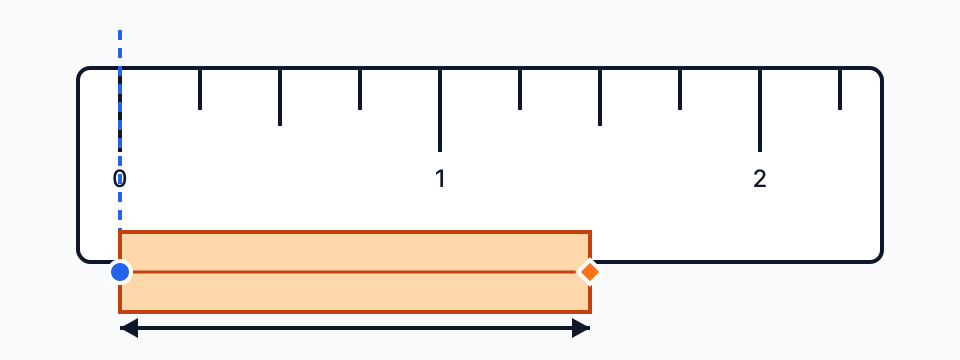
Good uses
Quick checks where a millimeter or two does not matter: sizing a ring or watch band, checking a screw against a spec, measuring a phone case, a photo print, a plant cutting or a piece of jewelry, or confirming that a downloaded pattern printed at the right scale. Small objects that fit on the screen are easier to place flat against the glass.
When to reach for a physical ruler
Anything longer than your screen, anything with legal, medical or financial consequences, and any task with a strict tolerance needs a physical ruler or calipers. The 1 mm ticks and 0.5 CSS px calibration steps describe scale and adjustment resolution, not physical accuracy. Curved monitors and thick screen protectors add error; the accuracy page explains the sources.
Actual-size ruler, printable ruler, or photo ruler?
This page is an actual-size ruler: the scale is drawn to match your calibrated screen. A printable ruler moves the problem to the printer, which must print at exactly 100% scale. The image measurement tool works the other way round — you mark one known distance on a photo and it scales everything else. Pick the tool that matches where the object is.
Devices and browsers
The ruler runs in any current browser on Windows, macOS, Linux, iOS and Android with JavaScript enabled. Full-screen mode uses the browser's Fullscreen API where it is available. The dedicated centimeter, millimeter and inch pages open with that scale selected; the unit tabs switch at any time.
How to use this ruler
- Check the calibration badge above the ruler. Until you calibrate, the ruler uses a screen-based estimate that can be far off on phones and high-DPI laptops.
- Click “Calibrate” and match the on-screen outline to a bank card, or enter your screen's diagonal size.
- Choose cm, mm or inch with the unit tabs, then hold the object flat against the screen with one edge on the 0 mark.
- Or press and drag along any ruler to read the distance in mm, cm and inches at once.