Inch Ruler (1/16 in)
An inch-first ruler with fractions down to 1/16 in on top. Calibrate once and measure in inches the way a real tape measure reads.
Display settings
Calibration details
Resulting density: 96.0 PPI · Not calibrated · estimate only
Verify against a physical reference. Different displays can report identical parameters; display changes cannot always be detected.
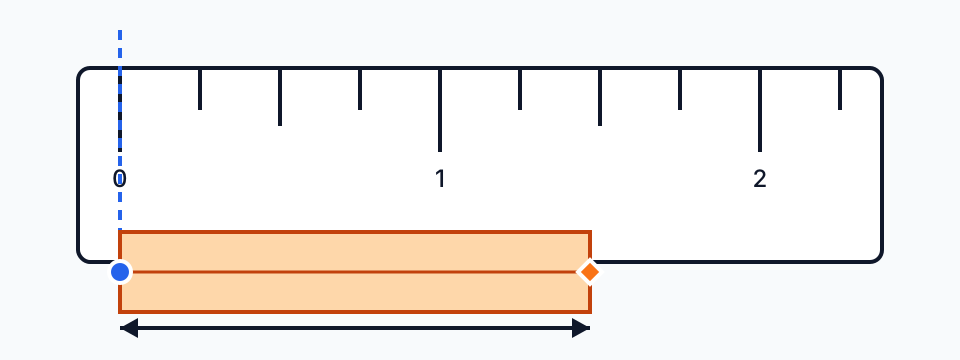
Press and drag across the ruler to measure a distance in cm and inches.
Keyboard: focus the ruler and press Enter to start at zero, then Tab to − or + to adjust.
Reading and using an inch ruler
The tick hierarchy
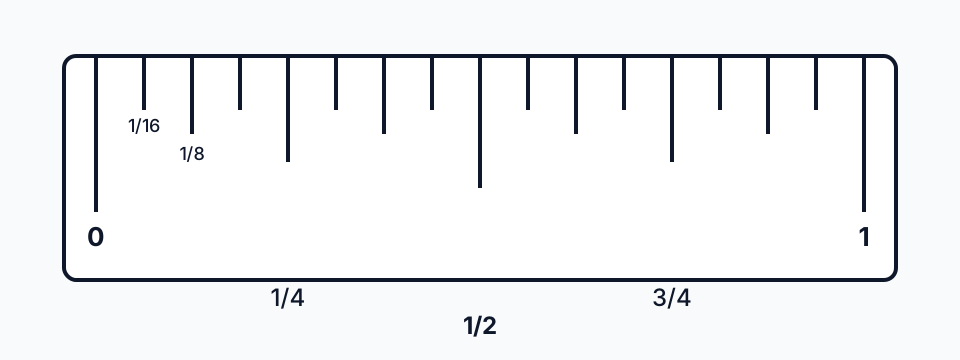
Inch rulers divide each inch by halving: 1/2, 1/4, 1/8, 1/16. On this ruler each level gets a shorter mark, so the pattern between two numbers reads long – short – medium – short – longer – short – medium – short – long. To read a position, find the last whole inch, then count the sixteenths.
Fractions, decimals and millimeters
Every sixteenth of an inch as a decimal and in millimeters, useful when a drawing gives one form and your tool the other.
| Fraction | Inches (decimal) | mm |
|---|---|---|
| 1/16 in | 0.0625 | 1.587 |
| 1/8 in | 0.1250 | 3.175 |
| 3/16 in | 0.1875 | 4.762 |
| 1/4 in | 0.2500 | 6.350 |
| 5/16 in | 0.3125 | 7.938 |
| 3/8 in | 0.3750 | 9.525 |
| 7/16 in | 0.4375 | 11.112 |
| 1/2 in | 0.5000 | 12.700 |
| 9/16 in | 0.5625 | 14.287 |
| 5/8 in | 0.6250 | 15.875 |
| 11/16 in | 0.6875 | 17.462 |
| 3/4 in | 0.7500 | 19.050 |
| 13/16 in | 0.8125 | 20.637 |
| 7/8 in | 0.8750 | 22.225 |
| 15/16 in | 0.9375 | 23.813 |
| 1 in | 1.0000 | 25.400 |
Feet and inches
Longer measurements are written as feet and inches. Divide inches by 12 for feet and keep the remainder as inches; 70 in is 5 ft 10 in. The unit converter shows feet alongside inches and millimeters.
Common imperial sizes
US Letter paper is 8.5 × 11 in and Legal 8.5 × 14 in; a standard business card is 3.5 × 2 in; a bank card 3.370 × 2.125 in; a nominal 2×4 stud actually measures 1.5 × 3.5 in. Lay any of them against the ruler to sanity-check the calibration, or read the metric equivalent on the centimeter ruler.
Inch reference tables
US hardware, lumber and everyday objects are specified in inches. Each table includes the metric equivalent from 1 in = 25.4 mm.
US screw sizes (Unified thread)
Small US screws use gauge numbers rather than fractions. The major diameter of a numbered size is 0.060 in + 0.013 in × the number, so a #8 screw is 0.164 in across. From 1/4 in up, the size is the diameter itself. The thread is written as size-threads per inch, for example 10-24 or 1/4-20.
| Size | Major diameter | In millimeters | Coarse threads per inch (UNC) |
|---|---|---|---|
| #2 | 0.086 in | 2.18 mm | 56 |
| #4 | 0.112 in | 2.84 mm | 40 |
| #6 | 0.138 in | 3.51 mm | 32 |
| #8 | 0.164 in | 4.17 mm | 32 |
| #10 | 0.190 in | 4.83 mm | 24 |
| #12 | 0.216 in | 5.49 mm | 24 |
| 1/4″ | 0.250 in | 6.35 mm | 20 |
| 5/16″ | 0.313 in | 7.94 mm | 18 |
| 3/8″ | 0.375 in | 9.52 mm | 16 |
Diameters follow ASME B1.1. Close sizes such as #8 and #10 differ by under 0.7 mm, so confirm with calipers or a thread gauge when it matters.
Nominal lumber sizes vs actual size
A “2 × 4” is not 2 by 4 inches. US softwood lumber is named by its rough-sawn size and then dried and planed, so the finished board is smaller. Plan cuts with the actual size.
| Nominal | Actual (in) | Actual (mm) |
|---|---|---|
| 1 × 2 | 0.75 × 1.50 in | 19 × 38 mm |
| 1 × 4 | 0.75 × 3.50 in | 19 × 89 mm |
| 1 × 6 | 0.75 × 5.50 in | 19 × 140 mm |
| 2 × 2 | 1.50 × 1.50 in | 38 × 38 mm |
| 2 × 4 | 1.50 × 3.50 in | 38 × 89 mm |
| 2 × 6 | 1.50 × 5.50 in | 38 × 140 mm |
| 2 × 8 | 1.50 × 7.25 in | 38 × 184 mm |
| 4 × 4 | 3.50 × 3.50 in | 89 × 89 mm |
Actual sizes are the dry dressed dimensions in the American Softwood Lumber Standard (PS 20).
Everyday objects in inches
These everyday US objects make quick calibration checks for the inch scale. A penny is exactly 3/4 in across.
| Object | Size (in) | Size (mm) |
|---|---|---|
| Quarter (25¢) | Ø 0.955 in | Ø 24.3 mm |
| Dime (10¢) | Ø 0.705 in | Ø 17.9 mm |
| Nickel (5¢) | Ø 0.835 in | Ø 21.2 mm |
| Penny (1¢) | Ø 0.750 in | Ø 19.0 mm |
| Dollar bill | 6.140 × 2.610 in | 156.0 × 66.3 mm |
| Credit or debit card | 3.370 × 2.125 in | 85.6 × 54.0 mm |
| US business card | 3.500 × 2.000 in | 88.9 × 50.8 mm |
| 3 × 5 index card | 5.000 × 3.000 in | 127.0 × 76.2 mm |
| 4 × 6 photo print | 6.000 × 4.000 in | 152.4 × 101.6 mm |
| Letter paper | 8.500 × 11.000 in | 215.9 × 279.4 mm |
How to use this ruler
- Calibrate first; the home page explains the bank-card method (a card is 3.370 in wide).
- Keep the inch tab selected. Numbered marks are whole inches; the long unnumbered mark is 1/2, then 1/4, 1/8, and the shortest marks are 1/16.
- Align the object's edge with 0, read the last whole inch, then count sixteenths past it and reduce the fraction (8/16 = 1/2).
- Drag along the ruler for a readout in decimal inches and the nearest 1/16 fraction at once.